
As a parent, it can be nerve-racking to see our children struggle, especially when they’re in the early stages of growth. Is that wobble normal? Should they be walking by now? Sometimes, it can feel too much like a guessing game.
But it doesn’t have to. If you’ve noticed your child struggling to stand or walk, there may be an underlying reason, such as metatarsus adductus. This is a foot condition that often affects infants and young children.
In this article, we’ll detail everything you need to know, from what it is to how it’s addressed and more.
Looking for paediatric podiatry in Northcote? Reach out to our team at the Ankle, Foot & Orthotic Centre today. We have years of experience supporting children’s foot health and giving it the attention it deserves.
Understanding Metatarsus Adductus
Metatarsus adductus is a fairly common congenital condition, affecting one to two babies per 1,000 births. It is a deformity in which the outer border of the foot turns inwards, creating an almost bean-like shape. This may appear minor at first, but without intervention, it may become more noticeable.
Aside from noticing the signs, an official diagnosis is made based on a physical examination of the foot. In some cases, additional scans such as X-rays, CT or MRIs may be recommended.
What Leads to Metatarsus Adductus?
There is no concrete cause of metatarsus adductus. However, there are several factors that may contribute to its development, such as:
- A lack of amniotic fluid during pregnancy
- The position of the baby in the womb
- Genetics
- Atypical foot structure
Signs You Might Notice in Your Child
Because metatarsus adductus affects the shape of the foot, many babies and children may struggle to walk or move confidently. Aside from the curved foot, you may notice clumsiness, unsteadiness, or wobbling as they move or stand.
Likewise, metatarsus adductus may also cause stiffening or increased flexibility of the feet. For instance, when corrected by hand, the foot may move back into a relatively normal position. However, in some cases, the foot may be too rigid and inflexible to move at all.
Treatment and Care Options
Metatarsus adductus is a very manageable condition. In many cases, especially when the foot remains flexible, it may naturally correct itself over a few years. In fact, one study found that 87-90% of flexible cases did not need any treatment.
However, if you suspect your child has the condition, it’s important to get their feet assessed and monitored. This may help you determine whether it may be worth addressing.
If the foot remains rigid and does not correct itself over time, there are several treatment methods that may help correct its position.
These include:
1. Stretching and Exercises
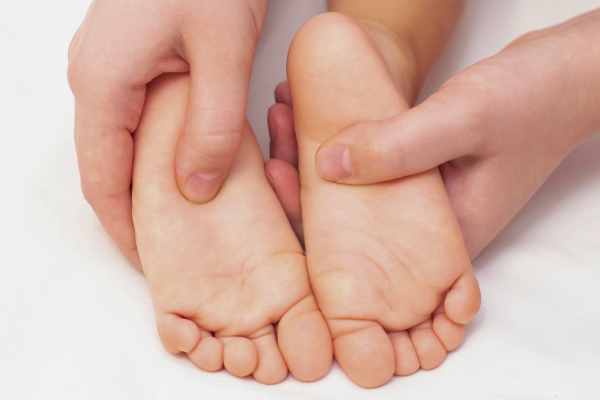
Stretching and gentle exercises are among the most common management options for metatarsus adductus. Usually, these involve holding the foot in the correct position for a few seconds at a time. The position may be held for longer if your baby is comfortable.
Another common stretch involves stroking the outside edge and front of your baby’s foot and leg. This may encourage the foot to move into a straighter position.
These stretches should always be conducted carefully to avoid discomfort or pain. If your child struggles with these, reach out to a podiatrist. They may be able to recommend other stretches or interventions.
2. Corrective Interventions
In more severe cases, where the foot is rigid or bent quite far, corrective devices may be used. Some children may benefit from custom orthotics or padded shoes.
These aim to gently correct the foot’s position over time. In other cases, splints or casts may be used. Casts are usually used before 12 months of age, as the infant is still growing.
At the Ankle Foot and Orthotic Centre, we make custom orthotics in-house, so your child may enjoy a better fit and faster support.
3. Sleeping Position
Adjusting the position in which your child or baby sleeps may also help correct their foot position. Consider gently rolling them onto their side or back, as this may help correct their feet and alleviate any additional pressure, turning their feet inwards.
Answering Common Questions About Metatarsus Adductus
Is there any way to prevent metatarsus adductus?
Because it is a congenital condition with no known cause, there is no known way to prevent metatarsus adductus from developing.
Does metatarsus adductus affect one or both feet?
Metatarsus adductus may affect one or both feet. In fact, one study found that 50% of cases were bilateral, meaning that your child has an equal chance of developing metatarsus adductus in one or both feet.
Is metatarsus adductus the same as club foot?
Though similar in some ways, metatarsus adductus and club foot are two distinct conditions.
Metatarsus adductus affects the top half of the foot, creating a curve that starts from the middle part of the foot. Club foot affects the entire foot, creating an inward curve from the heel to the toes.
How may the Ankle Foot and Orthotic Centre help?
At the Ankle Foot and Orthotic Centre, we are highly experienced in biomechanical corrections, whether through corrective devices such as orthotics, stretches, or other treatments.
If, for any reason, you feel your child needs support, reach out to our team. We’ll carefully assess their condition before tailoring a treatment plan that fits their needs.
Help Little Feet Find Their Way With the Ankle Foot and Orthotic Centre
If you’ve noticed your little one struggling to walk or a slight curve to their feet, there are ways we may be able to help. At the Ankle Foot and Orthotic Centre, we support children and infants with a wide range of foot concerns, including metatarsus adductus.
For tailored care that helps your child develop as they should, reach out to our team today to book an appointment.


